Amy Arbus

Amy Arbus is a photographer who grew up in New York City. She first gained recognition in the 1980s working for the Village Voice in the East Village, where she contributed to the column, On the Street. Through her lens she captured the urban fashion, eccentricity, and raw energy of downtown, New York. These photographs were later compiled into her 2003 book On the Street, 1980-1990. Among her most recognized images is an early photograph of Madonna – taken on St. Mark’s Place in the East Village. The same week the pop icon released her first hit single.
Other published works include “The Inconvenience of Being Born” (1999) and, “The Fourth Wall” (2008), both of which further explore her fascination with identity, and human performance within urban space.
Amy Arbus is also known as an educator, having taught photography at the International Center of Photography. Her work has been exhibited internationally in galleries and museums, including The Museum of Modern Art in New York.
Her parents, Diane and Allen Arbus, were both renowned photographers in their own right. Married early in their careers, they worked together as commercial photographers, producing assignments for publications such as Harper’s Bazaar and Esquire. They divorced in 1959 and pursued separate paths, though they remained close friends. Diane went on to become a prolific street and portrait photographer, while Allen pursued an acting career, and is best known for his role as Dr. Sidney Freedman in the TV series Mash.
*******
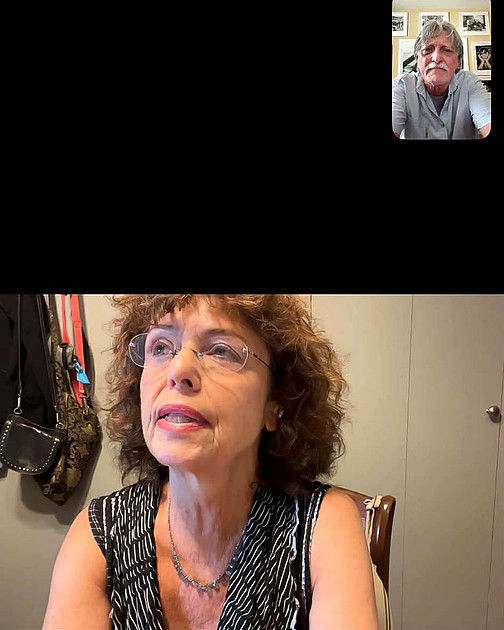
Facetime Call
Friday September 19, 2025
10:30am
Hi Amy
Hi
How are you? Finally, I get to do this with you, after all these years of trying.
Haha, you are persistent.
I am. I’m, very dedicated to my project.
Well, that’s great.
How have you been? Are there any current projects you’re working on right now? And are you still teaching at the International Center of Photography?
No, I’m not teaching anymore. I’ve been doing public speaking instead. I’m also working on a new series photographing circus performers, mostly acrobats. The photographs are in black and white, and they’re very sculptural - so the work is quite different for me.
Is that work based locally in New York City, or do you have to travel?
I’ve been traveling a little bit, but yes mostly local.
I appreciate you taking the time to do this short interview with me. Shall we get started?
Yes, absolutely.
*******
What first sparked your connection to photography when you were young? Was there a moment when you understood it was going to be part of your life?
I think it goes without saying that, both of my parents were photographers. But it didn’t Initially occur to me to become one myself. I felt it would have been redundant. They were already doing it – and then, in very different ways, both of them stopped. My father moved to California to pursue and acting career when I was about thirteen, and I my mother passed away (July 26, 1971) when I was seventeen.
I had always been making art of some kind, so it never occurred to me to be anything other than an artist. Photography just wasn’t the form I imagined for myself at first.
I never really tried photography until I was twenty-one. A friend of mine had been studying it, and one day she took me to the park. At the time we were living in Boston, where I was studying music at the Berklee College of Music. I remember taking a photograph of a little baby who looked like an old man. And I thought, Okay. I know I’ve got it. Something is here.
Looking back, I realize that moment was significant. It was the first time I understood that I saw things differently from other people. And all those years I had spent studying music just seemed to melt away.
You mentioned realizing that you see differently than other people. Can you talk more about what that felt like or what you noticed?
It wasn’t until I made the picture – seeing this baby who looked like a little old man – that I realized I had a different sense of beauty than most people. I also have a different sense of humor. I just knew there was something there.
At the time, I had been surrounded by child prodigies, and I was struggling to find my place. But the moment I made that photograph, I thought, this is something I might actually understand. It felt like I had an edge – not in a competitive way, but in the sense that I could finally recognize a way of seeing that was my own.
Do you recall your first camera, or the camera you were using at that time?
A Nikon F
I had taken a photography class in ninth grade. I was about fourteen. I remember using a Brownie Box camera and taking a picture of an apple on the roof. The assignment was to use the simplest approach to making a picture. At the time, I was known for having a big mouth – physically, not necessarily personality-wise. Amy laughs.
So, I took a bite out of the apple and photographed it against this very dark skyline. It ended up looking kind of spooky. People in the class started raving about the picture, and I completely freaked out. I felt like I was getting too much attention and praise for something I didn’t really feel I had any control over.
Were there specific influences on you then, or did the impulse to make images feel like it came from within?
I definitely didn’t have any photographic idols as a fourteen-year-old. But later on, I did. Part of that came from the fact that my mom kept pictures around her bed. Just seeing them all the time – whether I was fully aware of them or only half - paying attention – shaped the way I interpreted images. They settled into me this quiet, gradual way.
Are there any memories of your mother that you feel shaped your development as a photographer? Were there particular things she said or ways she worked that influenced you?
I listened and often helped. My sister, Doon, has handled my mom’s work for the last fifty years. One of the things I was asked to do was to listen to my mother’s teaching tapes. She had taught a workshop to professional photographers at Westbeth Apartments in the West Village, where we were living at the time. One of the men in her class didn’t speak English very well, so he taped the sessions.
I was stunned when I began transcribing the tapes. I realized how much I sounded like her - how I laughed like her, I shared her reactions and her opinions about any given photographer or photograph. It was just like; it was almost eerie.
I know that my mom was a great admirer of August Sander. I was definitely influenced by his straight forward approach – subjects simply standing looking at the camera, or just off to the side with a kind of quiet directness in their body language. I think he was my first inspiration, though of course, many others came later.
Did you attend any art schools or take photography classes?
I studied at the Museum of Fine Arts in Boston, where I worked with two photographers, Linda Connor and Bill Burk. Then in 1992, I took a workshop with Richard Avedon. That was the most transformational experience I’ve had as a photographer.
What are some of the highlights or memories of working with Richard Avedon?
Everything stands out. Amy laughs. I think the most incredible thing about working with him was his energy and his enthusiasm - his commitment to life - and his belief that photography could actually change the way people think. I worked with him through the International Center of Photography, where I was teaching at the time. He taught what he called a master class, and he selected sixteen of us to participate. It met once a month – an entire weekend each time – at his studio. He wasn’t a conventional teacher by any stretch of the imagination. When someone made a breakthrough or did something meaningful, his appreciation was boundless. He was the first person who made me take myself seriously as an artist.
What is the best advice you ever received?
Bill Burk once told me that I didn’t take enough pictures. I said I was afraid of taking bad ones. He looked at me and said, “You better get over that really quick.” And he was right – there’s no way to avoid taking bad pictures.
I try to capture moments that I’m not always consciously aware of seeing, so I blast away. And I’m a ruthless editor, especially with my own work. If something doesn’t stand the test of time, it’s out.
During 1980 through 1990, you worked for the Village Voice in the East Village. Can you speak about that experience?
I was a very shy kid back then - painfully shy and awkward, really. When I told stories, people would often look confused rather than enjoying the story. But over time, I became much more comfortable in front of people. I think I became a photographer partly to have access to people.
The people I photographed for the Village Voice were really cool people - creative, determined to succeed - whatever path they decided. They were all in. It felt like riding a wave with them. Many were performance artists, fashion people, musicians – people who later became known, even famous.
I remember photographing Madonna the week her first single was being reviewed in the Village Voice. No one knew yet, but you could feel something was about to happen.

How did you meet them?
Just by walking around.
What separates a great portrait from an average one? When you photograph someone, what are you trying to capture about them?
It’s a deceptively simple question. It appears easy to answer, yet it touches on something much deeper.
It’s about my instinct. I don’t always know exactly what I’m responding to, and I’m certainly not always right, but I can feel when someone intrigues me. If I’m able to photograph them, my hope is that my point of view might resonate with others as well. It’s not one specific thing every time. When I approach someone, my first concern is to help them relax – to ease any tension so they’re not posing or performing. What I’m really trying to get at is how they carry their feelings about life.
Think of Walker Evans’s subway portraits, taken without the subjects’ awareness. Those faces have ennui – that sense of simply being. People are most themselves when they’re not thinking about how they appear, when they’re not trying to be anything for the camera. They’re just there. That’s the place I try to reach with my own portraits.
When the medium moved from film to digital, how did that transition influence your work and your process?
I was pretty late to the party of digital. I didn’t officially switch over until around 2008. At the time, I was still working on assignment, so, I had one foot in each world – I’d shoot film and then digital. Digital was cheaper, faster, and more convenient. It was all those things. At a certain point.
Around then I was working on a project called After Images, where I photographed in the studio and dressed actors to resemble figures in classical paintings.
There were so many little details in those images that needed to be retouched – stray objects, a pen on a table, little things like that – and digital just made that part of the process more efficient. It didn’t make sense to keep all of that with film, so I switched over. I went kicking and screaming, but I eventually embraced digital.
I only moved to the mirrorless camera last year, and that was a revelation. It gave me another F -stop, which meant I could work faster and catch more of those in-between moments – the moments when people are most themselves. Using a mirrorless camera has been wonderful, and the printing quality now if fantastic.
I work with a lab called LTI, and I love working with them. Together, we fine-tune the files until they look the way I want them to.
What camera do you shoot with now?
I’m shooting with a Nikon 7II now. I love the warm tone I’m able to get with the prints – that’s been really satisfying. Digital printing has changed so much. I remember how terrible it looked around 2013; it felt cold and flat. Now, the detail is incredible. In fact, sometimes it can look too sharp. That used to be something I struggled with, but over time I’ve learned how to handle it and shape the files so they feel right to me.
What do you think of AI?
I think AI is a useful tool, but it’s not something I would have embraced if I didn’t need to. It can be very helpful, especially when there’s something distracting in a picture. That wasn’t intended. Being able to remove or adjust those things quickly is great. It’s a great tool but, I wouldn’t necessarily embrace it if I didn’t have to. I think it can be useful.
Looking back over your career, is there a particular moment or experience that stands out as one you’re especially proud of?
This past February, the Dolph Briscoe Center for American History acquired my archives. On Valentines Day, I sent forty-nine boxes to Austin, Texas. At some point, they’ll go through and catalogue everything. The idea that people will be able to study the work – especially the photographs from the 1980s all the way through to what I’m doing now – means a great deal to me. And not just the portraits. I also spent time photographing infants, which became a kind of sociological study of early expression and presence. I think that work will be meaningful to a lot of people in ways we may not fully understand yet.
Amy Arbus has been an artist for most of her life. Her creative nature revealed her photographic talent at the age of twenty-one, when - while photographing a baby with a friend – she discovered her ability to see in a different way. From that moment, she was hooked.
Her work has taken her into the worlds of fashion, portraiture, and street photography, each time with a sense of curiosity and connection. Amy’s photographs are known for their honesty, intimacy, and the way they reveal her subjects.
Over the course of her career, Amy’s photographs have been exhibited internationally and published in major art and culture publications. Her archives are held at the Dolph Briscoe Center for American History, in Austin, Texas, preserving her contribution to American photography.
More about Amy Arbus and her work can be found at www.amyarbus.com
