Neal Preston - Part 2
Philip Seymour Hoffman and Matt Damon
“One of the most amazing things with (the film) Almost Famous was witnessing the talent of Philip Seymour Hoffman. He portrayed Lester Bangs – the Rolling Stone and Creem Magazine journalist - but had never met him in real life. He was also sick during most of the filming. I don’t know how he did it but, he channeled Lester Bangs perfectly. I think Cameron had some video of Lester for Hoffman to study. But really, the only two people who knew Lester were Cameron and me. I’ll tell you - Philip Seymour Hoffman completely captured his vibe. He got it 101%. It still freaks me out.
The only other time I had that feeling was on the movie set of We Bought a Zoo. Matt Damon was in it. I was standing next to the camera, watching the monitor. In one scene Matt’s sitting on the kitchen floor with his laptop, looking at pictures of his late wife. Cameron called cut, talked to Matt and, said something quietly to him. They went for another take. Somehow Matt Damon moved just one muscle on the side of his face – and I’ve never seen anything like it. It completely changed the feeling of the scene. That’s what a good actor can do. I’d never seen anything like that before, and I’ll never forget it. How the fuck did he do that? But Cameron was an actor’s director - If you wanted to do an extra take, you did an extra take. Every crew we’ve ever had loved Cameron because he’s a music guy. They’ve all heard the stories about actors like Travolta and Nicholson, but now they want to hear about Jimmy (Page) and Robert (Plant). On one of the films during a break, it was a classic rock story hour at his lunch table.”
The Last Waltz
Can you tell us how the Last Waltz concert was like?
“I didn’t realize the significance of the Last Waltz until later, when everyone was raving about what a great show it was.” Neal is talking about a concert held by The Band on Thanksgiving Day on November 25, 1976, at the Winterland Ballroom in San Francisco. “I was focused on when Bob Dylan was coming out. I shot from the front so, my photos looked different.
I remember at the end of the show Stephen Stills wondered out on stage with Ronnie Wood. They’d been partying backstage, and during the last song, Stills decided he was going to plug in and play. In retrospect, that night was considered a triple-A show.”
Sid Vicious
I paged through Neal’s book - exhilarated and Exhausted - and stopped at a photo of The Sex Pistols, of Sid Vicious. “I noticed all of the scars and cuts on Sid’s chest. Were they self-inflicted?” I asked. “I assume so.” Neal said. “That was the last Sex Pistols show. They broke up about three hours after I shot that picture. I’m not a punk guy - never was a[CH1] punk guy,” Neal continued. “Somehow, I went to see a friend up in San Francisco, and they happened to be playing The Winterland. It was the last Sex Pistols show. I never got the whole punk thing. The audience was spitting on the band, and the band was spitting on the audience. In the picture, there is a goober on his guitar - and it covers up some tracks,” he said, referring to needle marks on Sid’s arm. “It says a lot.”
Bruce Springsteen
“Every once in a while, you have to look at things with a new set of eyes. When you’re on the road with a band for 2 weeks or a month, if you’re not careful you’ll start taking the same pictures again and, again. You know the show - you know where Bruce is likely to go, and at what point in the set. When he does a certain song, he’ll head to that part of the stage, put his arm around that guy. Some things just happen night after night. But if you fall into the trap of just waiting for those same moments, you’ll end up with twenty-nine shots of the exact same thing.
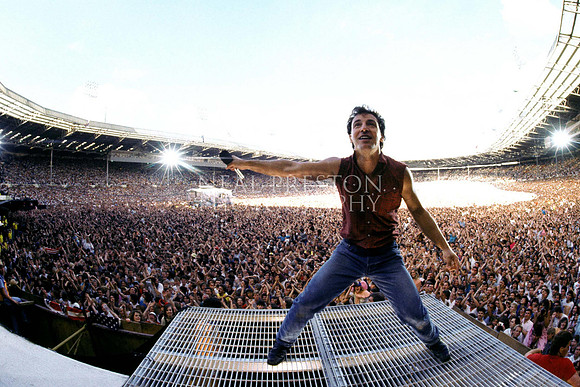
I just wanted to do something different, so I came up with the idea of having mounting a full-frame fisheye lens on a remote camera. First, I had to get the road crew to sign off on it - the stage is their domain. Anything behind the amps belongs to the crew, including me.
I wanted Bruce to know there was a specific shot I really wanted – one of him facing the camera. As, one of my editors use to say, ‘someone’s back can be more interesting than their face.’ But I’d had enough of his back. I figured it was a good time to pull this idea out, shake things up a bit, and try something new.
Before the show, I said to Bruce, ‘I’ve got a camera set up - you’ll probably notice it on the back railing of the little pod stage. If you remember, could you turn around and play to the camera? He didn’t respond at first, so I started walking out of the dressing room thinking, well, that didn’t go over so well. But then Bruce said, ‘Okay, I think I can do that.’
‘When the time came, I stood underneath the stage with my remote trigger dangling in my hand. I couldn’t really see what was happening but, through the slats in the wooden runway I, suddenly saw a pair of black boots running to the spot directly on top of me. I took a deep breath, counted to ten and, kept the button pressed on the remote cable, firing off 36 frames,’ according to Exhilarated and Exhausted by Reel Art Press.
Because, I was right underneath him, I didn’t know if he played for the camera or not, until I developed the film the next day. I’d hardwired the exposure control to the camera instead of using a wireless infrared trigger and preset the exposure. I knew it would be fine as long as the clouds didn’t roll in and darken everything.
Neal’s photo of Bruce Springsteen playing to the camera
I’ve done something like that with a couple of other bands here and there. I did it for my friend Phil - he’s the drummer for Kansas - and I got some of the best pictures I’ve ever taken of him. The camera was blocked off and pre-focused. As long as he didn’t stand up and pull a Keith Moon - the unpredictable drummer for the Who - and take his pants off at the drums or something, we were going to be fine.” Neal laughed.
Live Aid 1985
While I was paging through Neal’s book, I came to a photo of Freddie Mercury. “That’s Freddie at Live Aid,” Neal said. “Live aid was done with 18-minute sets.”
“I was the only still photographer on stage with Queen. After a while, you are not really looking - you’re just shooting on auto-pilot. It all happened so fast.”
“Was it difficult for you to hide?” I asked.
“Yeah, after Freddie’s first song, you see Freddie running across the stage. If you notice someone with curly hair trying to get away from him, and he’s ducking behind Brian May’s amp – that’s me.” Neal points to himself.
“I wasn’t trying to hide,” Neal said. “I was just making sure I didn’t trip over a cable. The camera guys are holding these huge cameras – nowadays, you can shoot the same thing with something a quarter of the size. See the guy holding the camera cable?” Neal pointed to a camera assistant in the photo. “If you trip over that cable, it could knock it out of the camera and pull the power from the feed. A billion TVs will go blank.”
A mutual love of Dogs
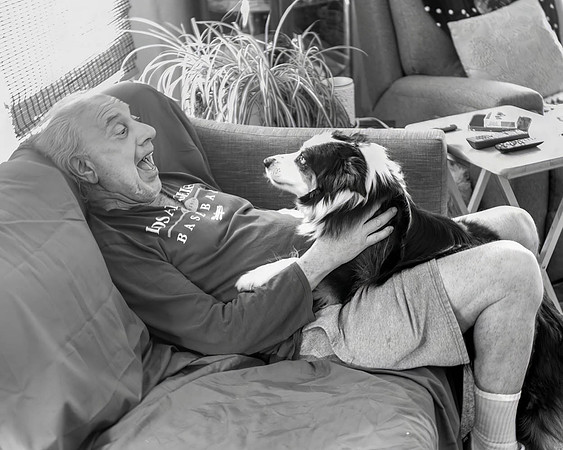
“Laurie and I have two dogs in Middlebury.” Neal said. “We have Panda - one of our dogs.” He pulls out his phone and shows us a photo. “He is a mini-Ausie.”
I give a fair amount of money to animal rescue.” Neal said. I’ll also donate some of my prints to sell. I believe very deeply in dog rescue - dogs are the best. It’s that unconditional love that they give you. You never get over losing one but, you kind of learn how to cope with it.” He paused for a moment and smiled. “We got Panda a week after we had to put one of our dogs to sleep, he had cancer. Laurie, was sitting at one end of the couch and, I was at the other. We both happened to come across Panda’s picture at the same time. That’s kismet - it was meant to be. Two days later, he was part of the family.”
Then he smiles. “And we adopted a blind Husky. She’s adorable too – all sixty-five pounds of her.”
He paused before adding, “The dog I rescued in Las Vegas a couple of months ago – a husky – the most gentle, mellow, chill dog I’ve ever met in my life. There’s never been a human she didn’t fall in love with. She was found in a garage with sixty other dogs.
“I think animals teach you patience and awareness”, Neal said. “You learn to read their energy - when to give space, when to connect. It’s not that different from photographing people or musicians. You’ve got to sense the moment before it happens, feel it coming. That’s when you press the shutter.”
He leaned back, smiling. “Whether it’s a dog I rescued or a rock star on stage, it’s all about trust. You can’t fake that. The best photos happen when there’s a connection - when they forget the camera’s even there.”
Middlebury
We leave Rockers and head to Neal’s home in Middlebury - another quaint little town just a twenty-minute drive from Vergennes.
My shot of Neal and his dog Panda
After a short visit with Neal and his two dogs inside the house, we moved to the backyard. Neal sat back on a lounge chair and looked straight into my camera lens. Every so often, he pushed his hair back, brushing it off his forehead.
I traded off between shooting Neal with my Roleiflex twin lens reflex camera and my Mamiya RB67 medium-format film camera. Neal stopped to watch as I set up my tripod. He noticed my Asahi Pentax spot light meter and smiled. “I haven’t seen one of those in a long time. I used one when I shot with my Hasselblad and my Mamiya RB67. A 67 is a perfect crop for a magazine page.
I turn on a photographic light and place it fairly close to Neal’s head. “Are you okay with this?” I ask. Neal replies, “yeah, yeah, yeah.” “I don’t want to drive you crazy.” I said. “No, no, no. It’s funny - I’m not an equipment junky. I have friends who always have the newest of the new, but I’ve never been that guy.” Cheri says, “Charlie kind of goes with the old faithful.”
“Mind you, I’ll stick with my old equipment until it’s dead and buried. One thing I absolutely abhor about my job these days is having to edit on a computer. Give me a loupe and some proof sheets baby and, I’ll get it done at one-tenth of the time. There are people who’ve never even seen one. I’ll hire some girls to work and, they’ll say ‘what is this?’ It’s the way we did it for a hundred some years.”
“I taught a class at the local Art School,” I said, “and the students didn’t know anything about film. So, if I made a reference back to the film era, they didn’t know of what I was talking about,” Neal adds, “And, then they want to know, what’s ASA? I know what ISO is. Who’s the genius who decided we had to change it over to ISO from ASA?” Cheri says, “I think now so many people just depend on their telephones.” Neal replies, “Yeah - or automatic program mode. Show me how to use program override, and I’ll figure the rest out myself.”
*******
“Do you have any plans of going out on tour with anyone?”
“Not currently, no. You know what? First of all, the traveling is too much. Even working on movies - like, when we start on the Joni Mitchell film - I don’t know if I’ll do the whole thing, because those hours are just too long. They have you up at 5 a.m. to be on set at 6:32. You know: hurry up and wait, hurry up and wait. Do an hour of work within 30 minutes. It’s a lot. I’ve been there, done it, and paid my dues. But I might go on the road with Stevie Nicks for a couple of shows when she starts up again. I’ll hit and run. I just can’t stand being on the road with anybody anymore. Those days are long gone – it’s not as much fun as it used to be. Everything is corporate now. “
*******
“Whenever you’re ready.” I said to Neal as I leaned down to the camera mounted on the tripod about three feet from the ground. Click. The shutter went off on the old Rolleiflex twin lens reflex camera, followed by the soft whir of winding film.
“I’m going to come a little closer to you, if you don’t mind,” I said. Does that freak you out?” “Oh, you’ll know if it’ll freak me out,” Neal replied. We all chuckle. “Make sure you get ‘the Dodge.’” Neal said, referring to his L.A. Dodgers T-shirt. “It’s my team, Baby,” he added with a grin.
“Can I try one thing?” Neal asked. “Sure, go ahead,” I reply. With each hand, Neal grabbed one of the tri-pods. He moves one light closer to the right side of his face, and the other light with his left hand close to his body - t-shirt level right at the height of the L.A. Dodgers logo.”
Creative block
Have you ever experienced a creative block? If so, how did you work through it?
“It doesn’t happen often. All artists hit creative blocks from time to time - I don’t think I’m anyone special in that regard. But they’ve never lasted long.
I’ve never over-created. A lot of times you go to a shoot not knowing what you’re going to do - you just know you’ve got it when you’ve got it. Especially working for someone like People Magazine back in the day - I knew what it took to get the lead shot, the opening image of a story. I knew that if there are girlfriends or boyfriends, sons, daughters or pets, you have to get them in a frame.
There are certain parameters to work within, and certain bases I have to cover. But if you think about all that too much, you can start to over think it.”
“Have you ever gone into a shoot with a plan, only to have the subject suggest something that changed your direction?”
“Always. That’s part of- it takes two to tango. Some people are more comfortable in front of the camera than others.
I always compare a photoshoot to a dance - I lead, the subject follows, and together we tango. And, when the stars align, it’s the best feeling ever. According to, Exhilarated and Exhausted by Reel Art Press.
If you’re in show business - maybe an actor or a musician - you’re used to cameras being around. But if you’re just someone off the street, you’re not totally comfortable in front of the camera. I can tell within ten seconds how it’s going to go. I might say, ‘this is going to be the best photo shoot you’ve ever had - you’re in good hands.’ As soon as they see one polaroid where they look good, they relax. You don’t want to come in with three ideas that someone hates – that’s just digging yourself into a hole you’ll have to work your way out of. You do a little research on your subject, and then you work it out together on shoot day.”
Proudest moment
“When you think about everything you’ve done, is there a moment that stands out as the one you’re most proud of?”
“I love that I had a photo on a Wheaties box.”
“That was Mary Lou Retton?”
“Yes – that was mine.”
“Also, I will never forget the first time I saw one of my photos – a shot of the band U2 - on the cover of Time Magazine. I was in Orlando, Florida, and had just gotten off a plane when I walked by a newsstand. It was one of those places where they have the same magazines spread out twenty times across a rack, so I saw it twenty times in a row. It shocked me. I thought, I made it, or at least, I picked the right thing to do.”
Ken Regan
“I always considered myself a photojournalist at heart. I always wanted to be the kind of guy which you could call me to shoot anything – and if it didn’t require some specialized technical knowledge, I could get the job done. Whether it was the World Series or Led Zeppelin, as long as it wasn’t something scientific that demanded expertise beyond photography, I wanted to be the consummate photojournalist.
I looked at Ken Regan and what he had done. When I started working with the Camera Five picture agency, Ken became my role model. In Ken, I could see it - I could see someone who had really done it. That’s why he was so important to my career.” Check out - All Access: The Rock ‘n’ Roll Photography of Ken Regan by Insight Publications.
“He was the consonant professional. He could shoot anything – and he could also overshoot anything. He’d Shoot way too much film and piss off all of his editors,” Neal joked. “He was living the dream and he loved working. He’d work seven days a week – and if he could squeeze in another job on day seven, he would. The only argument we ever had was when Ken and I were hired as official photographers for Woodstock 2. We got hardly any sleep - and I’m not talking chemical related. It was a tough job. We were driving two cars back to New York City from the festival site. Ken had taken another job that Monday, and I was so tired I could barely drive. I had to pull over every fifteen minutes. Ken kept saying, ‘I have to shoot Fucking Tony Bennett! You can’t go to sleep!’ So, I just gave it to him. That was the only bad words we ever had. I miss him. I really miss him. Ken passed away November 25, 2012. Ken knew everybody - and not just magazines or publishing. He did a lot of work for the Kennedy family. He was Teddy’s personal guy. To me, that’s for more fascinating than Jimmy Page, Stevie Nicks or whomever.
Another thing I learned from Ken - don’t shoot an entire job with just one camera. If that camera fucks up, you’re not covered. One of my first assignments was to shoot Ethal Merman of all people, at the Waldorf Astoria. I had a focal-plane shutter problem, and a flash-sync issue. I shot everything with one camera, and we didn’t end up with too many usable frames.
Since then, I’ve always worked with at least two or three cameras - rarely would I have more than three. As for lenses, I’d carry everything from a full-frame fisheye up to a 300mm or a 400mm telephoto, and I’d sometimes use teleconverters. Back then, zoom lenses weren’t as sharp as they are now. So, I’d stayed away from them. You’re always going to use a 24mm and 35mm, 85mm and 180mm – those were my go-to lenses. It wasn’t the same for every shoot or show, but those were the ones I used most often. Still to this day, they’re my favorites.
Peter Townsend
I gaze through the viewfinder of my Mamiya RB and shoot a photo of Neal. “Now, my eyes will find the camera,” Neal jokes. Cheri laughs and says, “That’s why you are who you are.” Neal grins and breaks into song, belting out the chorus of the Who’s Who Are You. “Who are you, who, who, who, who.”
Cheri says, “I couldn’t even tell you how many times I’ve played that song in my life.” “Not as many as me”, Neal replies with a laugh. “Have you heard any of Pete’s (Pete Townsend) solo stuff? He continues. “My favorite new record is Chinese eyes. He did some touring years ago where he played piano and told stories about songs. You can buy the stuff off his web site - It’s astounding stuff. I could go on all day about him.
First of all, he’s a certified genius - a mental-level genius.” Neal says. “Try to read his autobiography. It’s about six hundred pages. I knew what it was going to be about – a tortured genius. The smarter they are, the more tortured they are. The book is fascinating.
The last time we saw him, Cameron Crowe and I went to see The Who at Caesars. Pete always looks grumpy. He’s not actually grumpy - he just puts it on. He saw me and Cameron and said, ’Oh my god’. I had brought two prints for him to sign - one for me and one for Cameron. He signed mine right on his ass and he goes ‘It’s quite a fine ass, isn’t it?’.” We all laugh at Neal’s description. “I said, it’s not as fine as Princes’ ass was, and Pete pretended he didn’t hear me. What a songwriter. What a fucking songwriter.”
“We saw The Who at The Royal Albert Hall in 2007,” I said. “Oh Man,” replied Neal. “I’ve been there two or three times. The first time Cameron and I got flown over to London in the mid-seventies to do something with David Essex. And we found out there was a Tubular bells concert – Mike Oldfield at The Royal Albert Hall. So, we got fifth-row seats the day after we arrived in London.
They threw me out for snoring too loud.” We all burst out laughing as Neal added, “Cameron kept doing this,” mimicking a sharp elbow jab to the ribs. “It couldn’t have been quieter in there. You could hear a pin drop from a mile away.”
Wembley Stadium
“Have you ever been to the old Wembley Stadium?” asks Neal. “I remember being there when Queen was playing. Roger Taylor – Queen’s drummer – had a drum roadie come to me and said, ‘Preston, come with me.’ He takes me through a public bar, then through a smaller room, and then, a smaller one with a door at the end. He opens it - and, it’s this tiny little bathroom. Everything is gold-plated. He pulls out some coke, chops it up, rolls up a bill and says, ‘You are about to snort a line off the Queens personal leu.’ He didn’t mean Freddie - he meant the Queen.”
Christine and Courtney
“There’s one person I’ve always wanted to photograph- and don’t laugh - Christine Aguilara. I was actually scheduled to shoot her, but her tour got cancelled. For whatever reason, I’ve never been assigned to shoot her since. What a voice. Yeah, she’s cute and everything, but man she can sing.”
“One person I did get to shoot was Courtney Love. Talk about a genius - she is definitely at the mental level. I went out with her a couple of times.
The second date I had with her, we were in this really posh Italian restaurant - kind of music hang out in L.A. I was with a couple of friends and I said, ‘I’ll call Courtney, she just lives up the street.’ She actually picked up the phone, which was unusual. Ten minutes later, she walks in the place wearing a bathrobe. You know what? When she got up to go to the restroom, every woman followed her in there. They’re all fascinated by her. She’s really smart.
“David Crosby was brilliant - and crazy. Brian May… I don’t know if you’re aware of this, but he’s got a doctorate in astrophysics. He’s literally a rocket scientist. He co-wrote a book about the origin of the universe. He’s also the worlds’ leading expert in stereoscopic photography.”
The best and the worst person to work with
I prepared to take another photograph of Neal and he mugged for my camera. “Is there anyone that you’ve turned down to photograph?” I asked him. “There are people I would turn down after working with them once,” Neal replied. “People are always asking me, ‘who’s the best person to work with and who’s the worst. George Michael - pain in the ass. Generally, people try to be on their best behavior with me, but every once in a while, there’s just someone who doesn’t want to co-operate. It’s not me - it’s them.
“The other side of the coin is sometimes the subjects are thinking, do we really have to do this? Another shoot?” I tell them, here’s the deal - it’s a dance. I lead, and together it’s a tango. You can’t do it by yourself, and I can’t do it by myself. I’m the easiest guy in the world to work with. I’m not going to bark orders at you I’m not going to insult you, or say, this sucks. When I see the moment, I’ll say, don’t move. It’s not the poses - it’s the moments between the poses.”
A few Ozzy and Sharon anecdotes
During your experience with Ozzy and Sharon, can you speak about your time with them?
“Sharon had me go to Maui to shoot their wedding.” Neal says. “I also shot them at the Beverly Hills Hotel when they renewed their vows twenty or twenty-five years later. She has always been great with me and I consider them family - to a point.”
*******
“I’ll tell you one funny story about Ozzy. Funny enough, I was just thinking about this yesterday. I remember, being at their house shooting pictures for the final year of The Osbornes reality show. I had maybe an hour to do all these setups. I had assistance working on one set up while we were shooting another - a lot of work and, not enough time.
At one point Oz and I had about ten minutes to chill. He says, ‘Do you want to hear a couple of tracks from my new album?’ “Sure,” I said. So, he takes me into this den where the sound system is like the L.A. Forum. Madison Square Garden doesn’t have a sound system this good. He plays me a couple of tracks, and I say to him, ‘wow that second track is great. Who is playing guitar in that?’ He looks at me and says, ‘I don’t fucking know.’ That’s when I realized - he doesn’t know who plays on his albums! Sharon hires the studio guys. They come, they play. I don’t know who’s producing and, he doesn’t know nor does he care. I just thought welcome to Ozzys’ world.
The producer’s there - he’s the one in charge, watching the clock. He’s the guy looking at the clock, making suggestions on who to bring in. Sharon’s the manager - and she’s a very good one.”
*******
“I did an album cover for Ozzy after a gig one night - maybe it was in Irvine, or somewhere around there.” Neal recalls. “We took his chair out onto the stage, and I brought a couple of cans of cranberry sauce. I had Ozzy put the sauce in his mouth to look like fake blood.
We shot that right after the show, and afterward I had to drive him and Sharon home. They were in the back seat of my car - I had a white Jaguar at the time. Of course, we got caught up in the post-concert traffic going up the 405 back to town. Suddenly Ozzy says, ‘I gotta fuckin pee.’ I was all the way over in the left lane and couldn’t get over to the right. ‘Hold it in Ozzy, hold it in,’ I said. Thirty seconds later, Ozzy yells, ‘I can’t’. I’m desperately trying to get over to the right shoulder – and I finally make it. Ozzy barrels out of the back seat, already going. We’ll just say… we had to clean up afterward. Leave it at that.
The last episode of the Osbornes
“The fourth and final season of The Osbournes was filmed around the time they renewed their wedding vows at the Beverly Hills Hotel.” Neal recalls. “During the last seen there was, Sharon, Ozzy, me and – of all people - Britt Eklund in Ozzy’s dressing room, or his ‘get ready room.’ Ozzy had passed out on the couch. Sharon looks over at me and says, ‘I can’t even get laid on my fucking wedding night.’ I said, ‘Oh, you can get laid on your wedding night.’ She shot back, ‘I meant by my husband.’” Neal laughs.
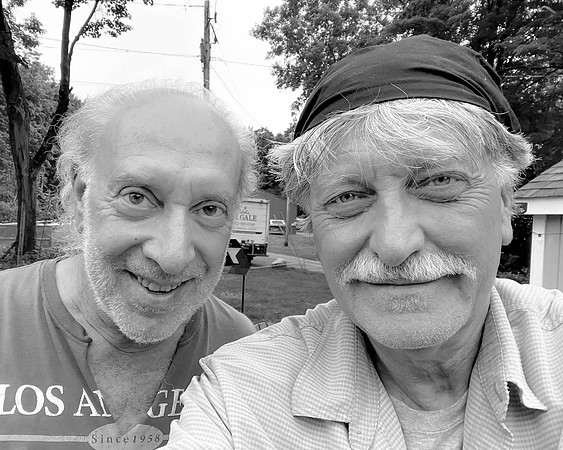
Neal and I pose for a selfie
The dedication, passion and, perserverance that Neal Preston has demonstrated throughout his career is truly unprecedented. From a young age, his love for both music and photography sent him on an endless journey down a rabbit hole that most can only dream of.
Photographers are different. Some are more different than others. It’s a gradual process of finding yourself. You develop a photographic taste, and it leads you to the next place – often in ways that are inexplicable. Neal has always possessed the rare ability to perceive, understand, and create images that reflect an innate photographic identity – one that feels inherited and entirely his own.
“Neal Preston has made a magnificent career, and more importantly a life out of the passion that lives in every frame he shoots,” as per, Cameron Crowe, Exhilarated and Exhausted, Reel Art Press.
There was a time of innocents, when Neal and his friends wondered a concert promoter’s office by accident, thinking it was a ticket box office. From that moment, a lifelong journey began - one filled with stories and anecdotes that only Neal can tell. Some of those stories had to be left out of this article for fear of their full reveal might uncover.
Neals’ photographs became more than just documentation of music history - they helped shape the very identity of the artists he captured. Many of whom became his close friends. His images give us purpose; they define how we remember our music heroes.
To borrow a line from Almost Famous, Neals’ photographs are incendiary.

Comments
No comments posted.
Loading...
|