Burk Uzzle
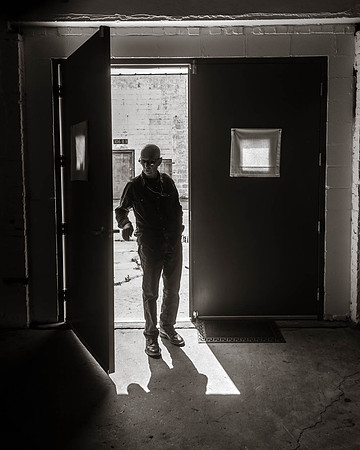

Photo by Charles Hahn
Burk Uzzle became the youngest photojournalist contracted by Life Magazine at the age of 23. A member of the Magnum group of photographers, Burk served as it’s President in 1979 to 1980.
Burk’s career spanned six decades and specialized in social justice. He helped document the post assassination and funeral of Matin Luther King Jr. However, his most iconic photograph was shot at the Woodstock music festival in 1969 and it became a kind of theme for the festival. It eventually became the cover of the record album by the same name, Woodstock. His life works and story can be seen in his 2020 documentary film F11 and Be There, directed by Jethro Waters.
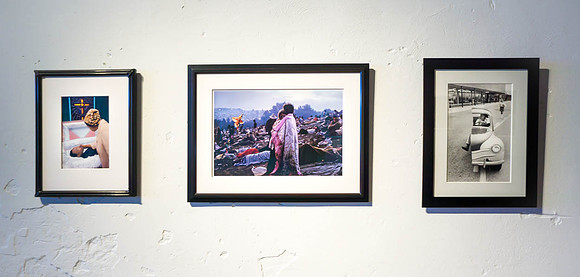
Photo by Charles Hahn
Wilson, North Carolina
Tuesday April 30, 2019
11am
I drove in between two old warehouses, put the car in park and called Burk on my cell phone. “I’m glad you made it okay.” Burk says. “Park in the back of the building and come in the door.”
I walked in the back door and Burk greets me as I entered the rear of the warehouse. Burk, a slight, thin and bald man reaches out his hand to shake. He is dressed in black. Black shirt, pants and shoes. He is wearing a pair of trendy plastic framed glasses with an octagonal shape. Burk is a very friendly man of eighty years in age as we exchange pleasantries and smiles.
His studio is in an old renovated warehouse with an inviting character and charm. Inside are tall ceilings and lengthy white walls which are covered with many recognizable photographs.
Burk calm and methodically walks me around his place. Explaining his recent change from film to digital and proudly shows off his Canon inkjet printer. Inside the editing room while Burk proudly shows off his printer, an old photo of Burk standing with Henri Cartier-Bresson is seen off to the side on the wall. Wow!
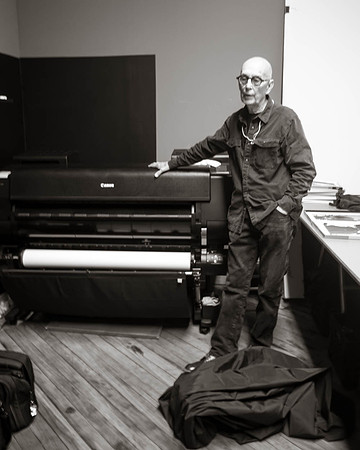
Burk stands with his Canon printer
Photo by Charles Hahn
A short anecdote about Woodstock
We walk along the wall where many of his photos hang and stop in front of his most recognized Woodstock photo. “Burk, I wasn’t there but I recall reading the weather was terrible.” I said. Burk agreed. “Yeah, I brought my wife and kid and we were trapped for three days. We couldn’t leave because of the stranded cars on the road. I was using a Leica camera and shielded it from the rain by tucking it under my jacket. I kept running out of film and came back towards the stage to borrow more from another photographer.”
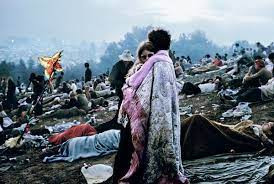
Photo by Burk Uzzle
The Martin Luther King Jr. viewing
To the left of the Woodstock photo was a photograph of Martin Luther King Jr. in his coffin with a young lady peering at him as she walked by. “They had a viewing for family and close friends in the early hours of the morning. It was about 5am, with a public viewing coming later on in the morning that day” Burk said. “I never knew who the young lady was in the photo but, during a gallery show many years later, someone approached me saying they knew that woman and mentioned her name to me. It was a mistress.”
Free-lance work for Life Magazine
“Were you employed by Life Magazine or did you free-lance for them?” I asked Burk. “I decided to free-lance for them. If I was an employee, I would have to sacrifice my photographs and lose my rights to them. I couldn’t own my photos. Owning them was important to me. But, being a contracted free-lance photographer meant I really had to hustle to be able to pay for insurance and incidentals.”
Burk opens an unmarked door in his studio and we step in. It appears to be a large walk-in closet with hundreds of boxes filled with negatives, photographs and slides. “This is my archive room.” Burk explains. “This is half of my archive. The other half are in the National Archives in Washington”
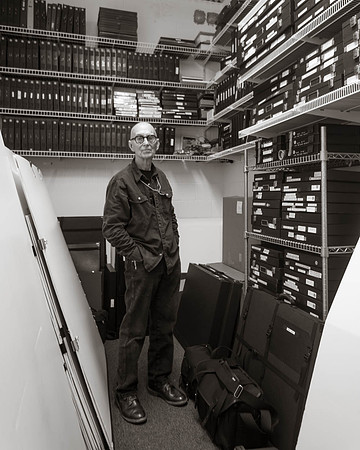
Photo by Charles Hahn
As my short visit came to an end Burk kindly asked to see my collection of photographs, offering up some compliments and critiques.
